
What is the Australian ITER Forum?
In 2005 Australian fusion scientists and engineers established the Australian ITER Forum to ensure that Australia is part of international fusion energy development programs, in particular the ITER Project, a large-scale scientific experiment that aims to demonstrate the scientific and technical feasibility of fusion as a energy source
What is Fusion Energy?
Fusion is a process by which two light nuclei join together (fuse) to form a heavier nucleus, and in doing so release considerable energy.
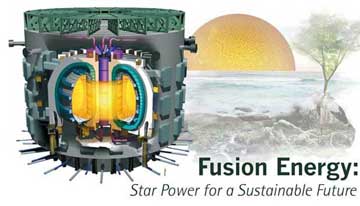
Image: Photomontage of rendering of next step fusion experiment ITER in an environmental setting. Fusion reactors promise vast quantities of electrical energy with zero greenhouse gas emission and no long lived radioactive byproducts. Montage Tim Wetherell, ITER rendering courtesy of New Scientist.
A particularly favourable fusion reaction for use on earth is that involving deuterium (D) and tritium (T). Deuterium is an isotope of hydrogen, so-called “heavy hydrogen”, and is found in seawater (about 33g per tonne). Tritium is an isotope of hydrogen, and is readily made from lithium, which is widely available, both from ore from the earth (4% in Australia) and also from seawater. In each D-T fusion reaction 17.6 MeV of stored energy is released, along with a Helium nucleus (He) and a neutron (n). This is about one million times the amount of energy released from a chemical reaction, e.g. the burning of fossil fuels. This is how so little fuel can produce so much energy when fusion is employed.
Plasmas and Magnetic Confinement
In order for the D-T nuclei to fuse as a result of their thermal motion, the temperature of the D-T mixture must be high. The temperature fo the solar core is about 15 million degrees C, but to release net energy on earth from D-T fusion reactions, the temperature of the D-T fuel must be higher, typically 100 million degrees C. At these temperatures matter exists in what is known as the plasma state, in which atoms are fully ionised into the electrically-charged electrons and ions. In this ionized plasma state magnetic fields may be used to confine the motion of the nuclei (magnetic confinement).
Confining such a plasma is not trivial, at present the optimal method employs strong magnetic fields in the shape of a torus (doughnut). Experiments on present day experimental machines have already exceeded the temperatures required in a reactor, and produced short pulses of significant fusion power (up to 16 MW peak). The physics understanding of a toroidally confined plasma is not yet complete and substantial efforts are being made to do this because it will possibly lead to ways of improving the magnetic confinement scheme and making it a practical reactor (easy to operate, maintainable and cheaper). Plasma confinement studies are carried out in Australia on the National Plasma Research Facility H-1 (a type of magnetic configuration known as a heliac) at the Australian National University (ANU).
Growing World Energy Demand? Fusion to the rescue
The world’s population is expected to exceed 20 billion by 2050. This increase will place huge demands on global energy supplies. It is widely accepted that the economically viable reserves of fossil fuels, currently our primary source of energy, are rapidly diminishing and environmental concerns of their use are increasing.
The rising population brings with it an increased demand for energy. In addition, the growth of energy demand. These facts combine to lead to a prediction of doubling of the world’s energy demand from 2000 to 2050. Fusion offers a sustainable, safe, environmentally-friendly, and economically competitive energy source. With fusion fuel in great abundance it appears to be the only truly long-term, environmentally-friendly solution to meet the world’s bulk energy demands.A typical modern electric power plant will produce ~1000MW. The table below shows the fuel consumption over one year at this rate. The high energy density of the fusion fuel and its abundance are compelling arguments to realise this source of energy.
| Method | FUEL |
| Coal | 2,700,000 tonnes |
| Oil | 1,900,000 tonnes |
| Fission | 28 tonnes of Uranium Oxide |
| Fusion | 100kg D & 150kg T |
Other helpful links
Updated ITER news can be found here.
ANSTO’s expertise in the development and characterisation of advanced materials used in extreme environments, such as nuclear reactors, as well as our capacity to irradiate materials with ions to damage them, is relevant to fusion research: more information can be found here.
More information about ITER in Australia can be found here.
About AINSE
The Australian Institute of Nuclear Science and Engineering (AINSE Ltd.) is an integral organisation for enhancing Australia’s and New Zealand’s capabilities in nuclear science, engineering, and related research fields by facilitating world-class research and education.
AINSE offers a range of programs and services to its members, including generous domestic and international conference support, scholarships for honours & postgraduate students and Early Career Researchers, and intensive undergraduate education schools. These benefits aim to foster scientific advancement and promote an effective collaboration between AINSE members and ANSTO.
We respectfully acknowledge the Dharawal nation as the traditional custodians of the land on which AINSE is located.
Copyright © 2019 AINSE | Powered by Astra

