
By Georgia Barrington-Smith
On Tuesday 19th May 2026, the annual AINSE Networking Dinner was hosted at the Sydney Masonic Centre, bringing together leaders and representatives from across the Australasian nuclear science and technology sector.
A major highlight of the evening was the formal presentation of the prestigious AINSE Scholar Gold Medals, awarded for outstanding excellence and impact in research. The 2025 recipients are:
- Dr. Bryce Mullens – Former AINSE PGRA scholar, The University of Sydney,
- Dr. Carl McCombe – Former AINSE PGRA scholar, The Australian National University.
AINSE President Prof. Ian Gentle and ANSTO CEO Shaun Jenkinson formally presented the medals to the recipients in front of guests including members of the AINSE and ANSTO Boards, university Pro Vice-Chancellors and Deputy Vice-Chancellors of Research, AINSE member representatives from across Australia and New Zealand, and senior executives from the Australian Radiation Protection and Nuclear Safety Agency (ARPANSA), AtkinsRéalis, and Fulbright Australia.
Following the ceremony, Dr. Mullens joined Prof. Ian Gentle on stage to discuss his AINSE-supported research and reflections on his academic journey, expressing deep gratitude for the world-class mentorship at ANSTO and the collaborative opportunities provided by the AINSE network.
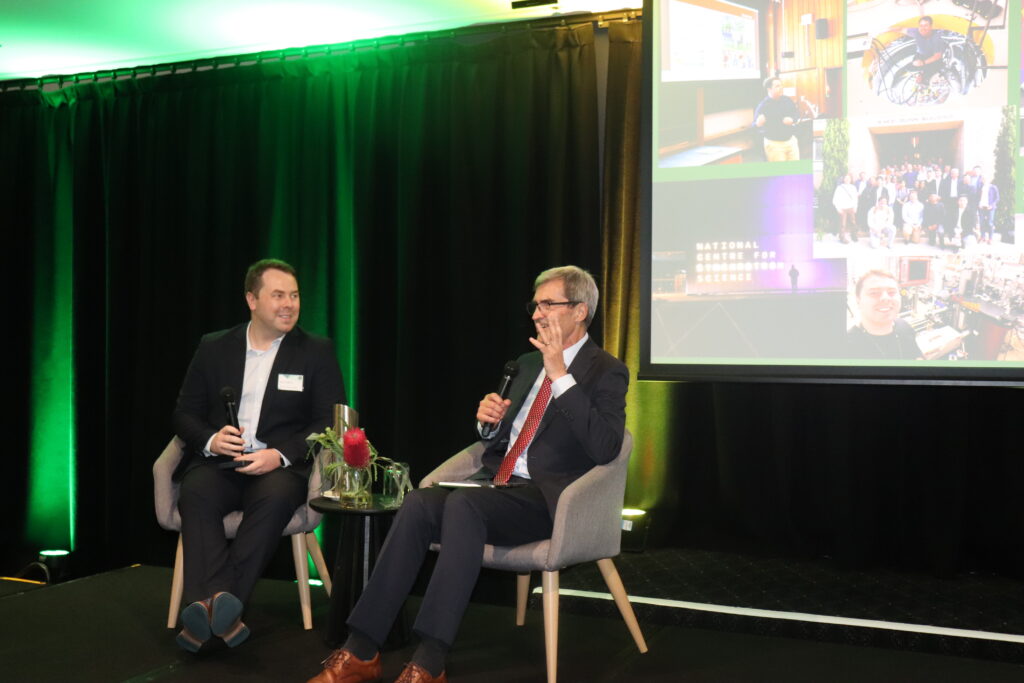
AINSE Gold Medallists
Dr. Bryce Mullens: Chaotic Simplicity – A systematic investigation of the structure-property relationships in simple ABO4 Metal Oxides
Dr. Mullens’s research has advanced the global development of carbon-neutral energy technologies by uncovering how the atomic structure of metal oxides controls their performance in applications such as solid-oxide fuel cells, solar hydrogen production, and nuclear waste immobilization.
Using advanced synchrotron X-ray and neutron diffraction techniques, he developed the first comprehensive models linking both long-range and local atomic structures to material functionality. These discoveries established new design principles for more efficient, durable, and commercially viable energy materials.
Key Research Impacts:
Next-Gen Fuel Cells:
He identified lanthanoid tantalates (LnTaO4) as superior alternatives to standard electrolytes used in solid-oxide fuel cells. His work demonstrated that these materials offer improved thermal stability, reduced degradation, and higher ionic conductivity, addressing key barriers to the large-scale adoption of carbon-neutral power. This work recognised through the AINSE-ANSTO French Embassies (SAAFE) Program, sought collaboration with international leaders in solid electrolyte design.
Solar Hydrogen Production:
Dr. Mullens advanced photocatalysis for sustainable fuel cycles by solving a long-standing mystery: why lead tungstate (PbWO4) is an industrially viable photocatalyst despite its toxicity, while the identical structure of calcium tungstate (CaWO4) is inactive. Supported by the United Uranium Scholarship, he used advanced neutron scattering at ANSTO and Oak Ridge National Laboratory (USA) to discover sub-nanometre structural distortions invisible to conventional diffraction. These distortions were present in photocatalytic ABO4 materials like PbWO4 but absent in their non-active counterparts. These insights established the design rules needed to engineer next-generation, non-toxic, and efficient photocatalysts for large-scale hydrogen production.
The global impact of his research is reflected in its widespread adoption, invited presentations, and a growing citation record, strengthening Australia’s reputation in advanced materials science.
Dr. Carl McCombe: Functional characterisation of Nudix hydrolase effectors from phytopathogenic fungi
Fungal diseases pose a severe and growing threat to global food security and the agricultural industry. Understanding how fungi cause disease is vital for engineering durable, broad-spectrum resistance in crops. During his PhD research at the Australian National University, Dr. McCombe set out to decode how fungi successfully invade plants and evade their immune defences.
A cornerstone of his research involved growing microscopic crystals of fungal proteins for analysis at the Australian Synchrotron. When exposed to intense X-rays, these tiny crystals revealed the intricate, three-dimensional shape of the proteins, allowing Dr. McCombe to map their functionality at a molecular level.
Key Research Impacts:
Uncovering Fungal Deception:
In groundbreaking research published in Science (2025), Dr. McCombe revealed that fungi use specialized proteins to trick plants into believing they are starving. This false starvation signal systematically weakens the plant’s immune system, allowing the disease to spread.
Dr. McCombe is currently continuing his work as a Resnick Pioneer Postdoctoral Fellow at the California Institute of Technology (Caltech). While he was unable to attend the ceremony in person, he expressed immense honour in receiving the Gold Medal and extended his gratitude to AINSE, his ANU supervisor Dr. Simon Williams, and ANSTO co-supervisor Dr. Daniel Ericsson.
The John Ferris Scholar Award
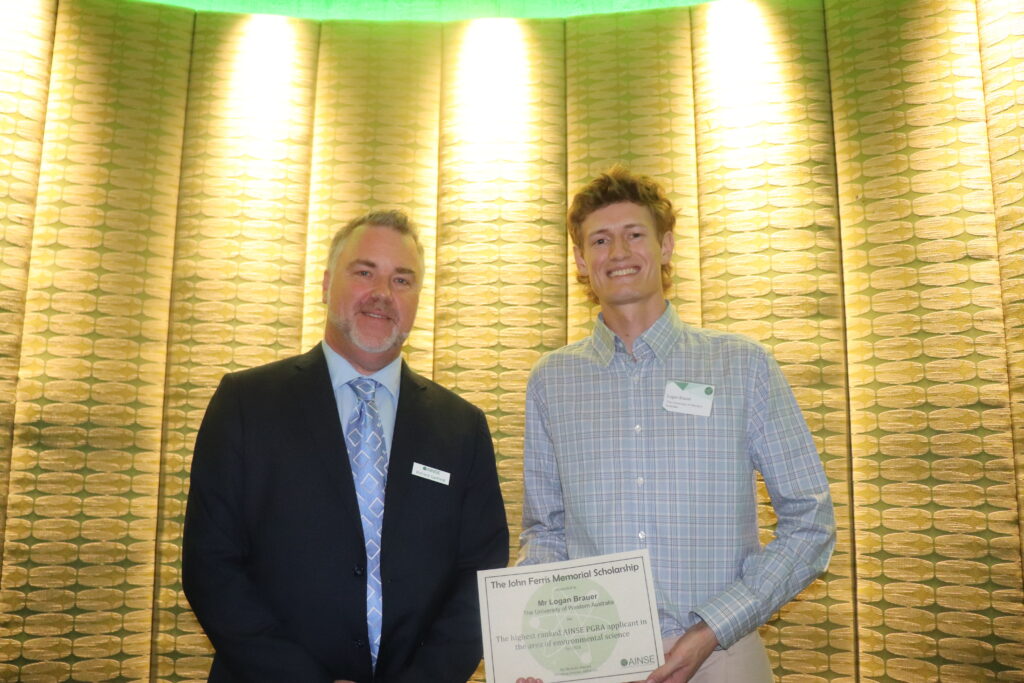
In addition to the Gold Medals, Logan Brauer from The University of Western Australia was named the John Ferris Scholar.
This award is held in memory of Dr. John Ferris, a cherished former ANSTO staff member and passionate environmental advocate. Dr. Ferris dedicated his career to researching ecosystem dynamics, radiation services, and the effects of radiation on non-human biota, work that significantly shaped international frameworks in the field.
This award is presented to the postgraduate scholar who achieves the highest rank in their PhD application for AINSE’s Postgraduate Research Award (PGRA) within the fields of Archaeology, Geosciences, and Environmental Sciences.
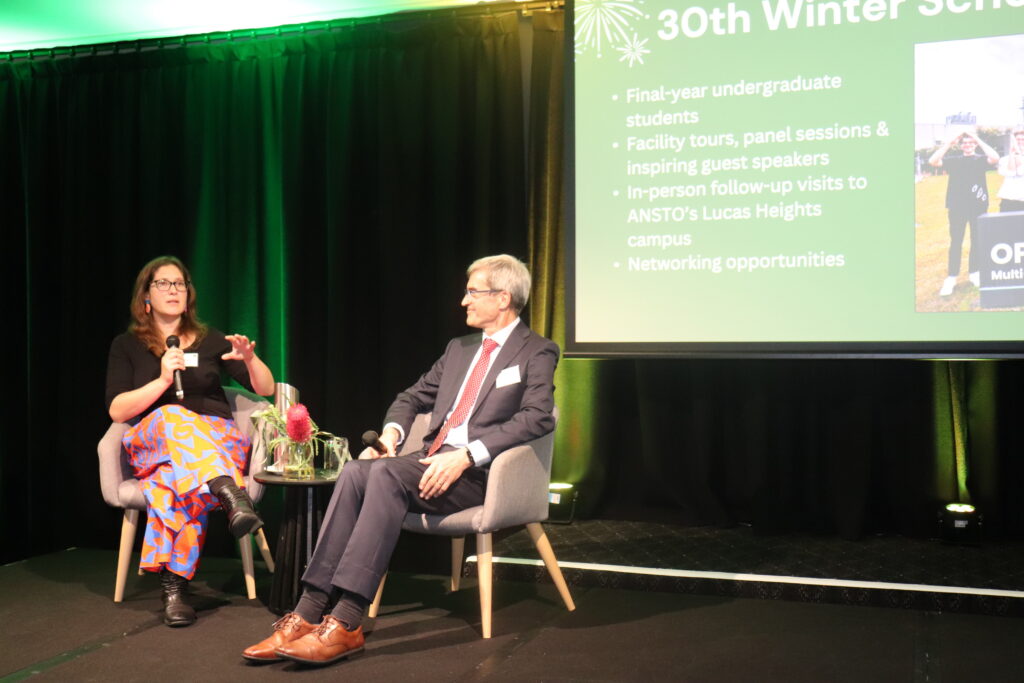
Celebrating 30 Years of the AINSE Winter School
To mark the upcoming 30th Anniversary of the landmark AINSE Winter School, President Ian Gentle sat down with the University of Tasmania Member Representative, Dr. Lydia Mackenzie.
Dr. Mackenzie reminisced about her own time as a former AINSE PGRA Scholar assisting at previous Winter Schools. She highlighted the electrifying atmosphere of the event and the invaluable opportunities it consistently provides for students to network with industry leaders, find potential PhD supervisors, and engage with cutting-edge research happening at ANSTO.
Supporting Nuclear Networks
Beyond honouring breakthrough research, the evening served as an invaluable hub for collaboration. AINSE took the opportunity to acknowledge select Member Representatives for their outstanding service over the past 12 months, particularly for their dedication to connecting Australian and New Zealand students with AINSE scholarships and education programs.
2025 Member Representative Service Awards:
- A/Prof. Amy Prendergast – The University of Melbourne
- A/Prof. Nathan Brooks-English – CQUniversity
- Prof. Gary Bryant – RMIT University
- A/Prof. Vladimir Golovko – University of Canterbury
- Dr. Lydia Mackenzie – University of Tasmania
- Prof. Chris McNeill – Monash University
- Dr. Ed Simpson – The Australian National University
- A/Prof. Cuong Ton-That – University of Technology Sydney
- Dr. Mihaela Grigore – CSIRO (in absentia)
- Prof. Godwin Ayoko – Queensland University of Technology (in absentia)
- Prof. Christopher Sumby – The University of Adelaide (in absentia)
Concluding the evening, AINSE Managing Director Michelle Durant celebrated the resounding success of this fourth annual dinner, noting her excitement for the ongoing partnerships, conversations, and discoveries that continue to unite the nuclear science and technology sector.