
Lung cancer in Australia
Lung cancer is one of Australia’s biggest killers. It is the fourth-most commonly diagnosed cancer and has the highest mortality rate of any cancer. Early detection is crucial, but current diagnostic methods face significant limitations.
Current imaging techniques
The first step in lung cancer diagnostics is a chest X-ray, a two-dimensional image that allows doctors to look for obvious abnormalities. If something suspicious is seen, a chest Computed Tomography (CT) scan is usually the next step. CT scans produce three-dimensional images, providing more detail about potential tumours. However, medical CT scans can only reliably detect tumours larger than 1 cm. Tumours of this size are often difficult to diagnose due to insufficient contrast or resolution in current imaging technologies.
When imaging is inconclusive, a biopsy is performed. This invasive procedure involves removing a small piece of tissue for testing, which can be painful and requires recovery time for the patient. Reducing the need for biopsies would improve patient comfort and outcomes.
Introducing phase-contrast X-ray imaging
Phase-Contrast (PC) X-ray imaging offers a promising solution. Unlike conventional X-rays, which measure absorption, PC imaging measures the refraction or phase shift of X-rays as they pass through tissue, providing enhanced contrast (Ahlers et al., 2025). This allows lung tissue — often difficult to visualise clearly using conventional medical X-rays and CT scans — to be seen with significantly greater clarity and structural detail (D’Amico et al., 2025). By improving image quality, PC imaging could enable earlier and more accurate tumour detection.
Research at the Australian Synchrotron
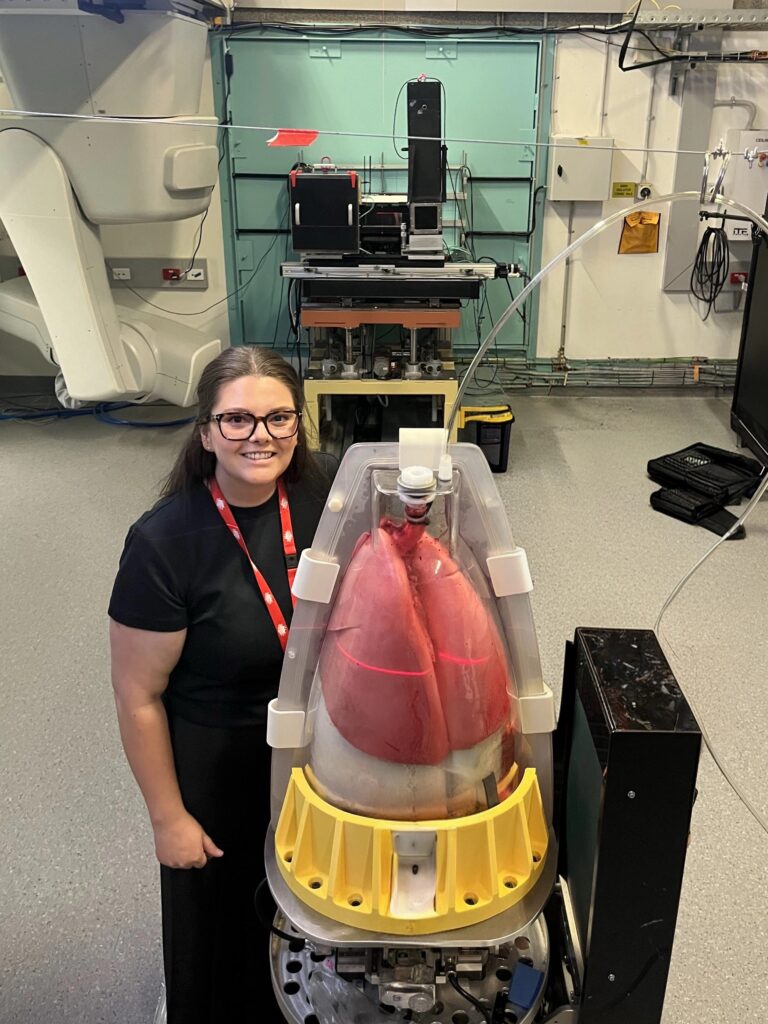
At the Australian Synchrotron, researchers are using the Imaging and Medical Beamline (IMBL) to perform high-resolution, low-dose Region-of-Interest (ROI) scans of suspicious lesions (Costello et al., 2025). These scans are non-invasive and allow for detailed imaging of small areas of pathology. This approach not only reduces radiation exposure but also has the potential to transform current CT imaging practices.
Lucy Costello, AINSE PGRA, is conducting research at the IMBL, performing high-resolution, low-dose Region-of-Interest (ROI) scans of suspicious lung lesions. As an AINSE Postgraduate Research Award (PGRA) scholar, Lucy’s work focuses on non-invasive, high-precision imaging of small pathological regions.
These targeted scans reduce radiation exposure while delivering exceptional image detail. This approach has the potential to significantly improve diagnostic confidence and transform current CT imaging practices.
Towards better patient outcomes
The goal of this research is to improve diagnostics and ultimately patient prognosis. By combining phase-contrast imaging with advanced synchrotron technology, clinicians may one day be able to detect lung cancer earlier, reduce the need for invasive biopsies, and provide more precise, and effective care for patients.
References:
Ahlers, J N, D′Amico, L, Bast, H, Costello, L F, Donnelley, M, Alloo, S J, Harker, S A, How, Y Y, Croughan, M K, Pollock, J A, Häusermann, D, Maksimenko, A, Hall, C, Gureyev, T E, Nesterets, Y I, Kitchen, M J, Pavlov, K M, Morgan, K S, 2025, ‘High-energy X-ray phase-contrast CT of an adult human chest phantom’, Scientific Reports, vol.15, no.1. Available at doi: 10.1038/s41598-025-14956-3
D’Amico, L, Costello, L, Nesterets, Y, Donnelley, M, Gureyev, T, Maksimenko, A, Beck, C, Ahlers, J, Smith, R, How, Y Y, Parsons, D, Hall, C, Hausermann, D, Cameron, M, Klein, M, Kitchen, M, Tromba, G, Dullin, C, Morgan, K, 2025, ‘In situ propagation-based lung computed tomography for large animal models’, Journal of Synchrotron Radiation, vol. 32, no. 6, pp.1511–1522. Available at doi: 10.1107/s160057752500832x
Costello, L, Donnelley, M, Nesterets, Y, Ahlers, J, Alloo, S, Hall, C, Hausermann, D, Kitchen, M, D’Amico, L, Morgan, K, 2025, ‘Evaluating the feasibility of region-of-interest X-ray phase contrast imaging for lung cancer diagnostics’, Scientific Reports, vol. 15, no.1. Available at doi: 10.1038/s41598-025-04509-z
Want to get involved?
If you, just like Lucy, are interested in conducting cutting-edge research in nuclear science with ANSTO, visit https://www.ainse.edu.au/scholarships/ to explore AINSE scholarships.
While you’re waiting for the next Research Spotlight, check out https://www.ainse.edu.au/research-spotlights/ to see the incredible work of past scholars.